Color plays an important role in resin products, from transparent decorative pieces and colorful jewelry to custom resin crafts and commercial products. However, achieving the right color involves more than simply choosing a beautiful shade. The type of colorant, resin compatibility, dispersion, and curing performance all influence the final result.
For DIY creators, selecting the right colorant helps achieve the desired appearance and avoid common application problems. For manufacturers, wholesalers, and craft brands, choosing suitable colorants is also essential for maintaining product consistency and developing reliable resin products.
With several options available, including liquid dyes, pigment pastes, mica powders, and other specialty colorants, how do you choose the right one?
This guide explains the key differences between resin colorants, what to consider before making a selection, and how to develop customized color solutions for different resin applications.
1. Why Does Choosing the Right Resin Colorant Matter?
The colorant you choose can affect both the appearance and performance of your finished resin product.
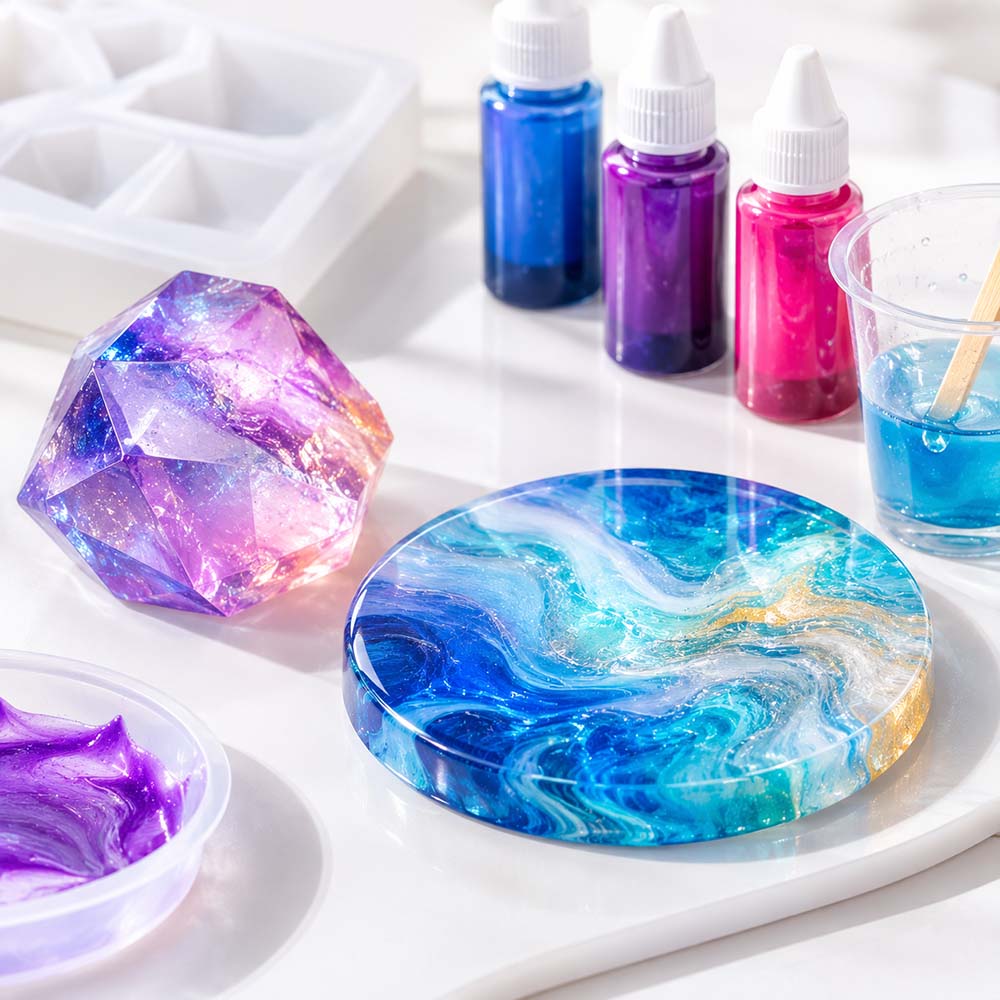
Different colorants produce different visual effects. Some create transparent, glass-like colors, while others provide solid coverage, metallic reflections, or pearlescent finishes.
Beyond appearance, colorant compatibility is equally important. An unsuitable colorant may cause uneven dispersion, unwanted particles, color separation, or changes in curing behavior.
When selecting a resin colorant, consider these important factors:
- Color Appearance
- Resin Compatibility
- Dispersion
- Color Strength
- Curing Performance
- Color Stability
For commercial production, these factors should be evaluated together rather than choosing a colorant based on appearance alone.
2. Understand Your Resin Type Before Choosing a Colorant.
Not all resin systems have the same chemical properties or coloring requirements. A colorant that works well in one material may not perform properly in another.
Before selecting a product, identify the type of resin you are working with.
UV Resin
UV resin is commonly used for jewelry, accessories, small decorative objects, and detailed craft projects. It cures under ultraviolet light, making colorant selection particularly important.
Liquid dyes are often used to create transparent or translucent colors, while compatible pigment pastes and mica powders can produce more opaque or decorative effects.
However, excessive colorant or highly opaque pigments may reduce UV light penetration and interfere with curing, especially in thicker applications.
When choosing a UV resin colorant, consider:
- Compatibility with the UV resin formulation.
- Transparency and light transmission.
- Color concentration and addition levels.
- UV curing performance.
- Final color appearance after curing.
Always test the selected colorant with the actual resin and curing equipment before production.
Epoxy Resin
Epoxy resin is widely used in river tables, artwork, jewelry, decorative accessories, coatings, and various craft applications.
Its versatility allows manufacturers and creators to experiment with many different color effects.
Common options include:
- Liquid resin dyes for transparent color effects.
- Pigment pastes for opaque and solid colors.
- Mica powders for metallic and pearlescent finishes.
- Specialty pigments for custom visual effects.
When selecting colorants for epoxy resin, pay attention to compatibility, dispersion, color strength, and the effect of colorant loading on the resin’s mixing and curing performance.
For larger casting projects, testing is particularly important because the final appearance may vary with casting thickness, resin formulation, and curing conditions.
Silicone Materials
Silicone materials are used in flexible molds, soft toys, decorative products, and various customized craft applications.
Unlike conventional epoxy systems, silicone formulations require colorants specifically compatible with the relevant silicone chemistry.
Silicone pigment pastes are commonly used to produce consistent colors in silicone products.
Important considerations include:
- Compatibility with the silicone system.
- Even pigment dispersion.
- Color consistency between batches.
- Flexibility and physical properties of the finished material.
- Stability during curing and storage.
For manufacturers developing colorful silicone products, a compatible pigment formulation can help achieve more consistent results across production batches.
Polyurethane Resin
Polyurethane resin is used in casting, decorative components, prototypes, and other specialty applications.
Colorant selection depends on the specific polyurethane formulation, including its chemical components, curing conditions, and intended application.
Not every epoxy or UV resin colorant is automatically suitable for polyurethane systems.
Before selecting a colorant, evaluate its compatibility with the resin components and confirm that it does not negatively affect curing or the physical properties of the finished material.
The key takeaway: Always select colorants according to the specific resin system, rather than assuming one product can be used across all resin applications.
3. Different Types of Colorants for Resin
Liquid Resin Dyes
Liquid resin dyes are commonly selected when transparent or translucent color effects are desired.
They can create bright, clear colors while allowing light to pass through the finished resin.
Typical applications include:
- Transparent resin jewelry.
- Colored resin decorations.
- Clear casting projects.
- Resin accessories and artistic crafts.
Their concentrated format also makes it possible to adjust color intensity gradually.
However, solubility and compatibility depend on the specific dye chemistry and resin formulation. Always verify that a liquid dye is designed for the intended resin system.
Pigment Pastes
Pigment pastes are used when stronger, more opaque colors are required.
They contain pigments dispersed in a carrier system and are available in a wide range of shades.
Common applications include:
- Solid-color resin products.
- Opaque decorative castings.
- Colored silicone crafts.
- Custom resin components.
A suitable pigment paste should provide good dispersion and compatibility with the target material.
For commercial applications, color consistency and the influence of the pigment loading on the final material properties should also be evaluated.
Mica Powders
Mica powders are popular for creating decorative effects in resin crafts.
Unlike dissolved dyes, mica particles reflect and scatter light, producing shimmering or pearlescent appearances.
Popular effects include:
- Metallic finishes.
- Pearl effects.
- Iridescent colors.
- Color-shifting effects.
- Fine shimmer effects.
Mica powders are frequently used in resin jewelry, decorative artwork, coasters, ornaments, and other creative products.
The final appearance depends on the particle characteristics, base resin transparency, background color, and application technique.
Transparent vs. Opaque Colorants
Mica powders offer a different category of visual effect, creating reflective surfaces rather than simply transparent or opaque colors.
Choosing between these options depends on the appearance and performance requirements of your finished product.
4. Key Factors to Consider When Selecting Resin Colorants
Resin Compatibility
Compatibility should always come first.
| Feature |
Transparent Colorants |
Opaque Colorants |
| Light transmission |
Allows light through |
Blocks or reduces light transmission |
| Appearance |
Clear, glass-like color |
Solid, covered color |
| Common options |
Compatible liquid dyes |
Pigment pastes |
| Typical applications |
Jewelry, clear casting |
Solid-color decorations |
Different resin systems have different chemical compositions. A colorant designed for epoxy resin may not be suitable for UV resin, silicone, or polyurethane.
An incompatible colorant may cause poor dispersion, separation, unexpected color changes, or curing problems.
For B2B product development, compatibility testing should be performed using the actual resin formulation whenever possible.
Color Strength and Concentration
Color strength determines how much colorant is required to achieve a particular shade.
Highly concentrated colorants may offer more flexibility in color adjustment and help reduce the amount of material needed.
However, adding too much colorant can negatively affect the final product.
Start with the recommended addition level from the supplier and adjust gradually through testing.
Dispersion and Mixing Performance
Even color distribution is essential for producing consistent resin products.
Poor dispersion may result in:
- Color streaks.
- Uneven shades.
- Visible pigment particles.
- Color separation.
- Inconsistent appearance between batches.
The appropriate mixing method depends on the colorant format and resin formulation.
Curing Performance
Colorants can influence resin curing, particularly in UV-curable systems.
For UV resin, excessive pigment concentration or opacity may prevent sufficient UV light from reaching deeper areas of the material.
For epoxy and polyurethane systems, colorant compatibility and loading levels should also be evaluated to ensure that the curing process and final material properties remain acceptable.
Color Stability
Color stability matters when products need to maintain their appearance over time.
Heat, UV exposure, environmental conditions, and the chemical properties of the resin may influence the finished color.
For products intended for commercial distribution, stability testing under expected storage and application conditions is recommended.
5. Common Mistakes When Coloring Resin
Even with a suitable colorant, incorrect selection or application can affect the final result.
1. Choosing Colorants Based Only on Appearance
Two products may produce similar shades but have very different chemical properties.
Always check resin compatibility before selecting a colorant.
2. Adding Too Much Colorant
Higher concentrations do not always produce better results.
Excessive colorant may affect curing, transparency, or the physical properties of the finished material.
3. Using the Same Colorant for Different Resin Systems
Epoxy, UV resin, silicone, and polyurethane have different formulation requirements.
A universal colorant should never be assumed suitable without supporting compatibility information and testing.
4. Ignoring the Final Application
A colorant suitable for a thin resin coating may not perform the same way in a thick casting.
Consider the product’s dimensions, curing method, desired appearance, and intended use.
5. Skipping Sample Testing
A small-scale test can help identify compatibility and performance issues before larger production runs.
For manufacturers and wholesalers, sample evaluation is an important part of product development.
6. Custom Resin Color Development for Brands and Manufacturers
For brands, wholesalers, and craft product manufacturers, standard colorants may not always meet specific product requirements.
Custom color development provides more flexibility when developing new resin products, matching brand colors, or creating distinctive DIY craft kits.
At DIY Resins, we focus on customized resin materials and product solutions for different business needs.
Our customization services can support several aspects of product development.
Custom Color Matching
Whether you need a specific brand color, an existing product shade, or a new color combination, customized color development can help achieve the desired appearance.
Color references, physical samples, and application requirements can be used to guide the development process.
Custom Formulation
Different applications may require different material properties and colorant combinations.
By considering the resin type, application method, desired appearance, and processing conditions, suitable material and colorant combinations can be evaluated through testing.
Custom Resin Kit Development
Beyond supplying individual materials, DIY Resins also supports customized resin kit development.
For wholesalers, retailers, and private-label brands, a complete kit can combine different materials and accessories according to the target market and product concept.
Customization may include:
- Resin material selection.
- Matching colorant combinations.
- Customized color sets.
- Packaging and product combinations.
- Private-label kit development.
- Application-specific material solutions.
Whether you are developing a beginner resin craft kit, a professional casting set, or a customized product line, the right material combination helps create a more complete product offering.
7. How to Choose a Reliable Resin Colorant Supplier
For businesses purchasing resin colorants in bulk, choosing a supplier involves more than comparing product prices.
A reliable supplier should understand both the materials and their intended applications.
Product Range and Compatibility
Look for a supplier that can offer colorant options for different resin systems and clearly communicate their intended applications.
Customization Capabilities
If your business requires specific shades, customized formulations, or branded product sets, check whether the supplier can support product development.
Sample Testing
Request samples before placing a large order. Testing helps evaluate color appearance, compatibility, dispersion, and curing performance.
Consistent Supply
For wholesalers and brands, consistent product specifications and reliable batch-to-batch quality are important for maintaining long-term product lines.
Communication and Technical Support
A supplier should be able to understand your application requirements and provide relevant product information during the selection process.
Working with a supplier that understands customized materials can make product development and purchasing more efficient.
Conclusion
Choosing the right colorant for resin involves balancing appearance, compatibility, dispersion, curing performance, and long-term stability.
Liquid dyes, pigment pastes, and mica powders each offer different advantages. The best choice depends on the resin system, desired visual effect, and final application.
For individual creators, understanding these differences helps produce better resin crafts. For brands, wholesalers, and manufacturers, selecting suitable colorants is an important step in developing consistent products and customized craft solutions.
At DIY Resins, we provide resin materials, colorants, and customized resin kit solutions for businesses looking to develop their own product lines.
Have a specific color or resin product in mind?
Contact our team to discuss your requirements for custom colors, material selection, formulation development, or customized resin kits.
We welcome inquiries from wholesalers, craft brands, retailers, and product developers.
Contact DIY Resins for Custom Solutions.
 How to Choose the Right Colorant for Resin
 How to Use Liquid Dyes for Candles and Wax Melts
 Why You Should Your Preheating Candle Jar