A candle’s fragrance is an important part of the overall candle experience. It can influence the atmosphere of a room, contribute to sensory memories, and change the way a space feels once the candle is lit.
However, achieving a balanced and consistent scent throw involves more than simply adding fragrance oil to wax. The type of wax, fragrance concentration, wick selection, pouring temperature, curing time, and the characteristics of the fragrance itself can all affect how a candle performs.
Understanding these factors can help candle makers make more consistent decisions during formulation and testing. This applies whether they are making candles at home, producing small batches, or developing products on a larger scale.
This guide explains how fragrance oils in candles behave, the difference between cold throw and hot throw, and how fragrance load affects performance. It also covers the key factors to consider when developing and testing scented candles.

What Are Fragrance Oils in Candles?
Fragrance oils are formulated scent blends designed for use in products such as candles, soaps, wax melts, and other home fragrance applications. Depending on the formulation, they may contain a combination of aromatic compounds and other ingredients intended to provide stability, consistency, and suitable performance in a specific product system.
In candle making, fragrance oils in candles are formulated to disperse throughout the wax and release aromatic compounds as the candle is used. Their performance can vary considerably depending on the fragrance composition, wax type, concentration, wick, and processing conditions.
Fragrance oils can represent many different scent profiles, including fruits and botanicals, perfumes, seasonal aromas, and gourmand notes such as vanilla and bakery accords. Woods, spices, and spa inspired compositions are also common.
Some formulations are described as phthalate free. This refers specifically to the absence of certain phthalate ingredients and should not, by itself, be interpreted as an indication of overall candle performance. When selecting a fragrance, candle makers should consider the complete formulation, intended application, and relevant supplier documentation.
The Science Behind Fragrance Oils in Candles
One of the basic concepts in candle formulation is scent throw. It describes how fragrance is perceived from a candle under different conditions.
When a candle is unlit, fragrance molecules can gradually migrate to and evaporate from the wax surface. The scent perceived under these conditions is commonly referred to as cold throw.
When a candle is burning, the flame heats the wax and creates a liquid melt pool. Fragrance compounds are released from the heated wax and diffuse into the surrounding air. The scent perceived while the candle is burning is known as hot throw.
Cold throw and hot throw do not always develop in the same way. A candle may have a noticeable scent when cold but produce a relatively weak aroma when burning. The opposite can also occur.
This difference can be influenced by several factors, including wick size, fragrance concentration, wax compatibility, fragrance composition, melt pool development, and curing time. Understanding the relationship between these factors is an important part of moving from basic candle making toward more controlled formulation and testing.

Fragrance Load: Finding the Appropriate Range
One common misconception among beginners is that increasing the amount of fragrance oil will automatically produce a stronger smelling candle. In practice, fragrance performance is not simply proportional to fragrance concentration.
Fragrance load refers to the amount of fragrance oil used in relation to the amount of wax. For example, if 16 ounces of wax are used, an 8% fragrance load based on wax weight would correspond to 1.28 ounces of fragrance oil.
The appropriate fragrance load depends on the wax manufacturer’s specifications, the characteristics of the fragrance oil, the desired performance, and the limitations of the candle system.
Many container candle formulations fall within a fragrance load range of approximately 6% to 10%, but this should not be treated as a universal rule. Different waxes have different maximum fragrance capacities and may perform differently even when the same fragrance concentration is used.
Using excessive fragrance can create formulation and burning problems rather than improving scent throw. Depending on the system, it may contribute to poor combustion, an unstable or oversized melt pool, fragrance separation, excessive soot, or wick performance issues.
For this reason, professional candle development generally focuses on finding an appropriate balance between fragrance concentration, wax characteristics, wick performance, and burn behavior rather than simply maximizing the amount of fragrance oil.
How Temperature Affects Fragrance Oils in Candles
Processing temperature is another factor that can influence fragrance performance.
Fragrance oil is typically added to melted wax at a temperature high enough to allow proper incorporation and dispersion. For some soy wax systems, fragrance addition temperatures may fall within approximately 170°F to 185°F. However, the appropriate temperature depends on the specific wax and should follow the manufacturer’s technical recommendations.
Adding fragrance at an unsuitable temperature may affect how effectively it incorporates into the wax. Excessive heat may also affect certain fragrance components, while insufficient heat can make uniform mixing more difficult.
After the fragrance has been incorporated, the wax should generally be poured within the temperature range recommended for the specific wax system. Pouring temperature can affect the finished candle’s appearance, crystallization, adhesion, and overall consistency.
Therefore, fragrance addition temperature and pouring temperature should be treated as formulation variables rather than fixed numbers that apply to every candle.
Think Like a Candle Formulator
Instead of asking, “What is the strongest fragrance oil?” it is more useful to consider how a particular fragrance performs within a specific candle system.
A fragrance that performs well in one wax may behave differently in another. The same fragrance can also produce different results depending on container diameter, wick series, fragrance load, curing conditions, and the environment in which the candle is burned.
For this reason, candle development is often a process of controlled testing rather than relying on a single formulation.
A simple testing approach is to keep the major variables consistent. Use the same wax, container, wick series, fragrance load, curing period, and testing environment when comparing different fragrances.
When evaluating fragrance concentration, change only the fragrance load while keeping the other conditions consistent. This makes it easier to determine whether differences in scent throw are actually caused by the fragrance concentration rather than another variable.
Over time, structured testing can help identify which fragrances perform consistently, which ones change significantly during burning, and which fragrance components become more or less noticeable when combined with others.
Fragrance Oils vs. Essential Oils in Candles
The difference between fragrance oils and essential oils is another common topic in candle making.
Essential oils are aromatic materials obtained from plants through processes such as distillation or expression. Their composition is determined largely by the botanical source and extraction method.
Fragrance oils, by comparison, are formulated blends that can incorporate a wider range of aromatic materials. Their composition can therefore be designed to achieve particular scent profiles and performance characteristics.
Essential oils can provide botanical and natural positioning benefits, but their suitability for candles varies considerably. Some have relatively low thermal stability or may produce limited hot throw depending on their chemical composition.
Fragrance oils generally offer a broader range of scent profiles and can be specifically formulated for applications where controlled fragrance performance is important. However, not all fragrance oils behave identically, and their performance should still be evaluated within the intended wax system.
The choice between fragrance oils and essential oils therefore depends on several considerations, including scent profile, formulation requirements, intended positioning, stability, cost, and performance.
How to Make Candles Smell Stronger
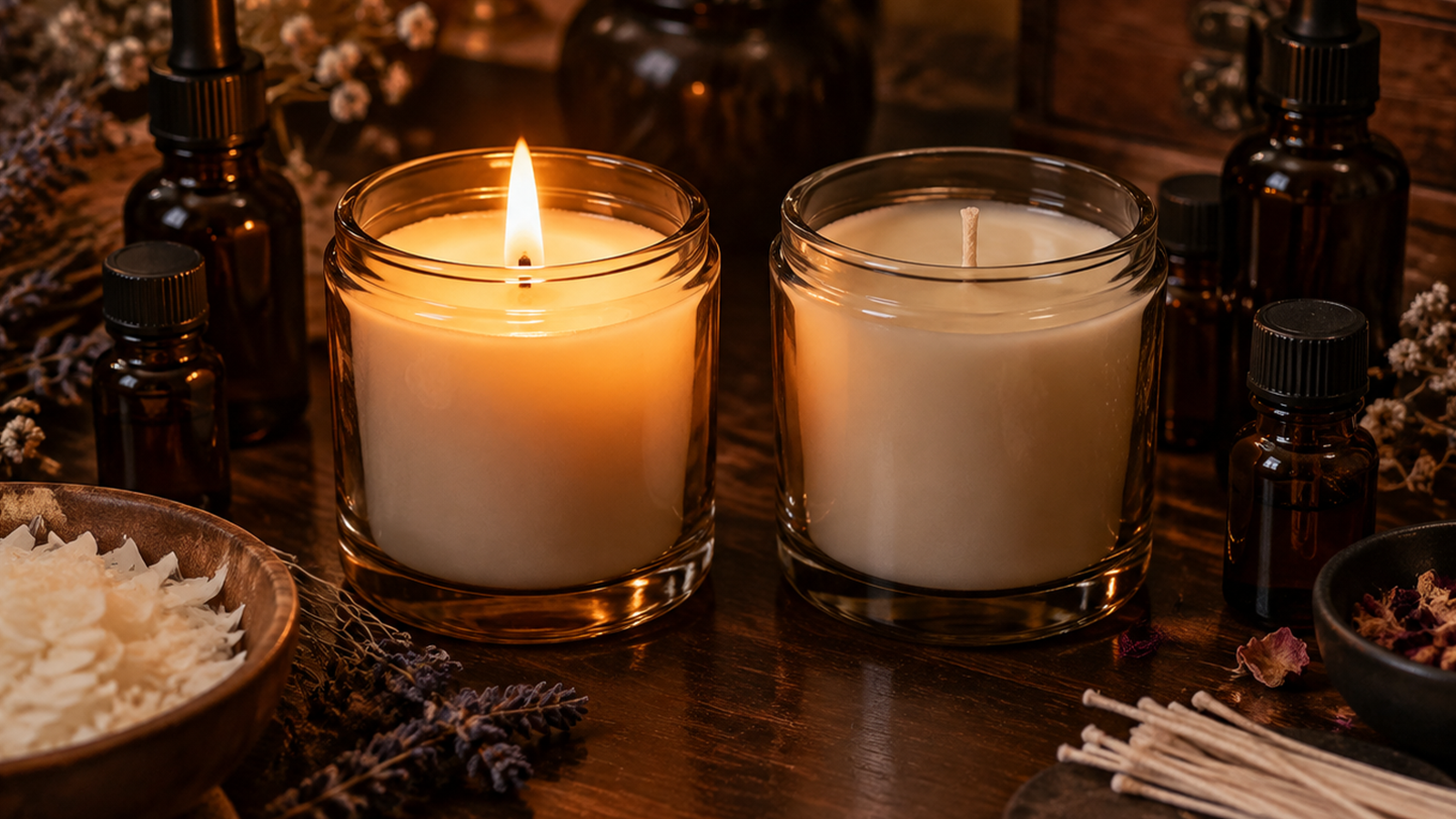
If a candle has weak hot throw, increasing the fragrance load is not necessarily the first solution. It is more useful to examine the entire candle system.
The first factor to consider is the fragrance itself. Different fragrance compositions can have significantly different evaporation characteristics and perceived intensity. Two fragrances used at the same concentration may therefore produce very different results.
Wick selection is equally important. A wick that is too small may not generate enough heat to create an appropriate melt pool, which can limit fragrance release. A wick that is too large, however, can produce excessive heat and an unsuitable burn.
Wick selection should therefore be tested together with the specific wax, container, and fragrance formulation.
Curing time can also affect fragrance performance. Soy wax candles, in particular, are often allowed to cure for several days to one or two weeks before performance testing.
The appropriate curing period varies depending on the wax and formulation. Comparisons should always be made after equivalent curing times.
Wax selection is another important variable. Different waxes have different structures and fragrance holding characteristics, which can affect both cold and hot throw.
Soy wax, paraffin, beeswax, coconut wax, and blended waxes may therefore produce different results with the same fragrance oil.
Finally, fragrance blending can be used to develop more complex scent profiles. However, combining fragrances also introduces additional variables. Blends should therefore be evaluated systematically rather than assuming that adding more fragrance components will automatically improve performance.
From Beginner to Pro: Understanding the Whole System
The difference between basic candle making and more advanced formulation is not simply the ability to create a stronger smelling candle.
More consistent candle development requires an understanding of how fragrance, wax, wick, temperature, fragrance load, curing time, and container dimensions interact with one another.
A strong scent throw is only one aspect of candle performance. A well developed candle should also burn in a controlled manner, maintain a suitable melt pool, remain physically stable, and provide a consistent fragrance experience throughout its intended use.
This is why structured testing is so important. Rather than changing several variables at once, candle makers can evaluate individual factors and record the results.
Over time, this approach makes it easier to understand the behavior of different fragrance oils and develop formulations with more predictable performance.
Ultimately, fragrance oils in candles are not simply about adding more oil. Good results depend on a balance between material selection, formulation, processing, and testing.
Once these relationships are understood, candle makers can make more informed decisions about fragrance load, wax selection, wick sizing, curing, and processing conditions.
FAQ
What is the ideal fragrance load for soy candles?
There is no single ideal fragrance load for every soy candle. Many formulations use approximately 6% to 10%, but the appropriate level depends on the specific wax, fragrance oil, container, and wick system.
The wax manufacturer’s recommended fragrance capacity should always be considered.
Why is my candle not producing a strong hot throw?
Weak hot throw can have several causes, including an unsuitable wick, insufficient curing time, low or excessive fragrance load, poor fragrance compatibility with the wax, or an unsuitable fragrance composition.
Testing these variables individually can help identify the cause.
What temperature should fragrance oil be added to soy wax?
For some soy waxes, fragrance oil may be added around 170°F to 185°F. However, there is no universal temperature for all soy waxes.
The wax manufacturer’s technical specifications should take priority.
How can I make homemade candles smell stronger?
Start by evaluating the fragrance oil, fragrance load, wick size, wax type, and curing time.
Increasing fragrance concentration alone does not necessarily improve hot throw. In some cases, it can create burning or formulation problems.
What are hot throw and cold throw in candles?
Cold throw refers to the fragrance perceived from an unlit candle, while hot throw refers to the fragrance perceived while the candle is burning.
Because the conditions are different, a candle’s cold throw and hot throw can vary significantly.
How long should a soy candle cure before testing?
The appropriate curing period depends on the wax and formulation. Many soy candle makers allow several days to approximately one or two weeks before evaluating fragrance performance.
For meaningful comparisons, candles should be cured for the same amount of time under similar conditions.